Filters vs. Criteria
The most important concept to master when searching in Taleva is understanding the difference between Filters and Criteria.
- Filters work through traditional keyword matching and are designed to build your initial search pool.
- Criteria, on the other hand, are searched by meaning using AI rather than literal keyword matches.
Properly separating these two phases will allow you to:
- Generate a higher volume of relevant results.
- Avoid overly restrictive searches that accidentally exclude talent.
- Evaluate complex, abstract requirements without losing valid candidates.
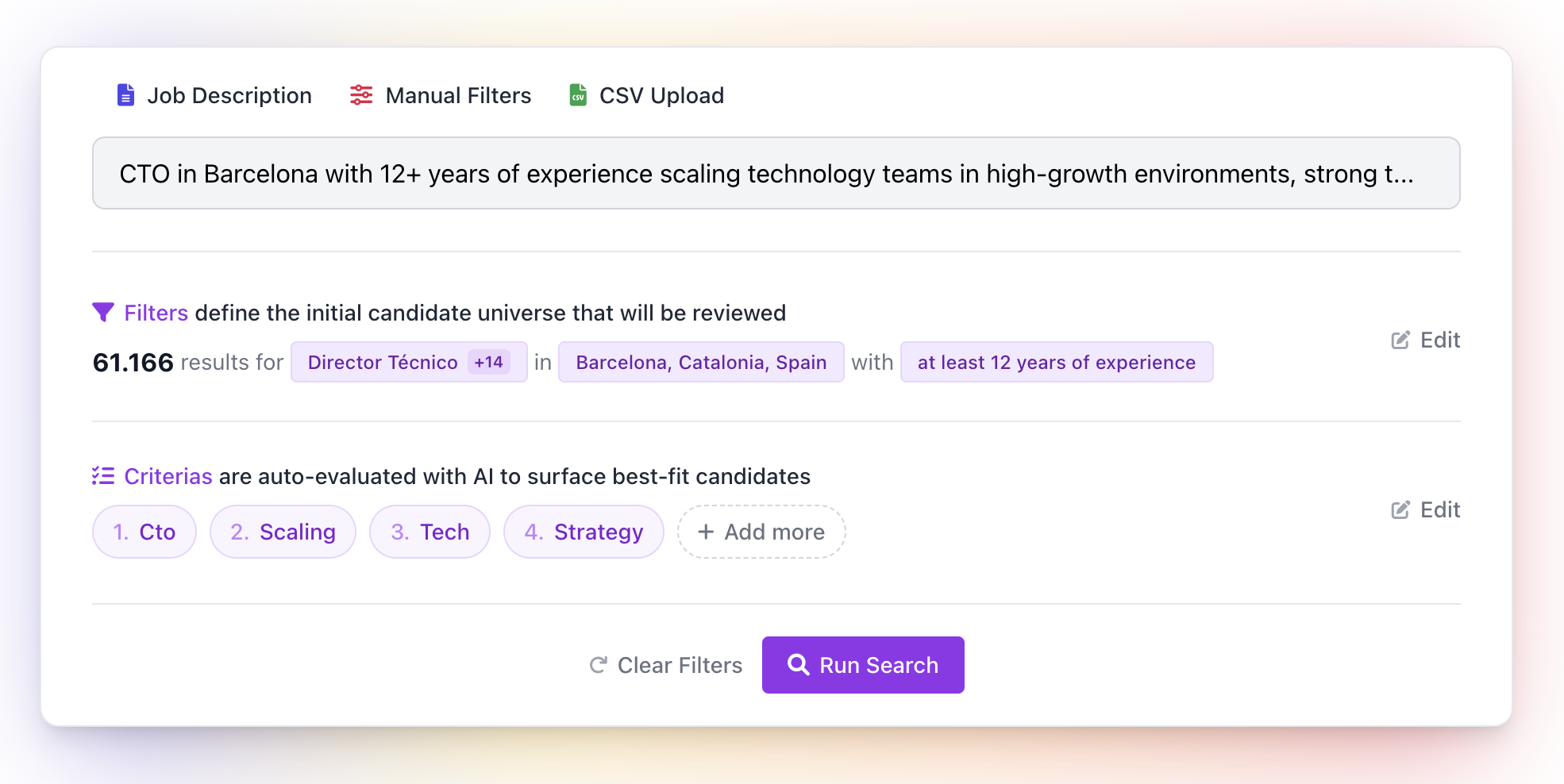
Phase 1: Filters (Building the Universe)
Filters handle everything you would traditionally do with boolean or keyword searches. This is where you define "hard" requirements such as:
- Location
- Years of Experience
- Job Title
Example of Requirement Separation
Imagine you are looking for the following profile:
- Software Engineer
- 5+ years of experience
- Based in Barcelona
- Startup experience
- Built products from scratch
- Team leadership experience
In Taleva, these requirements are split as follows:
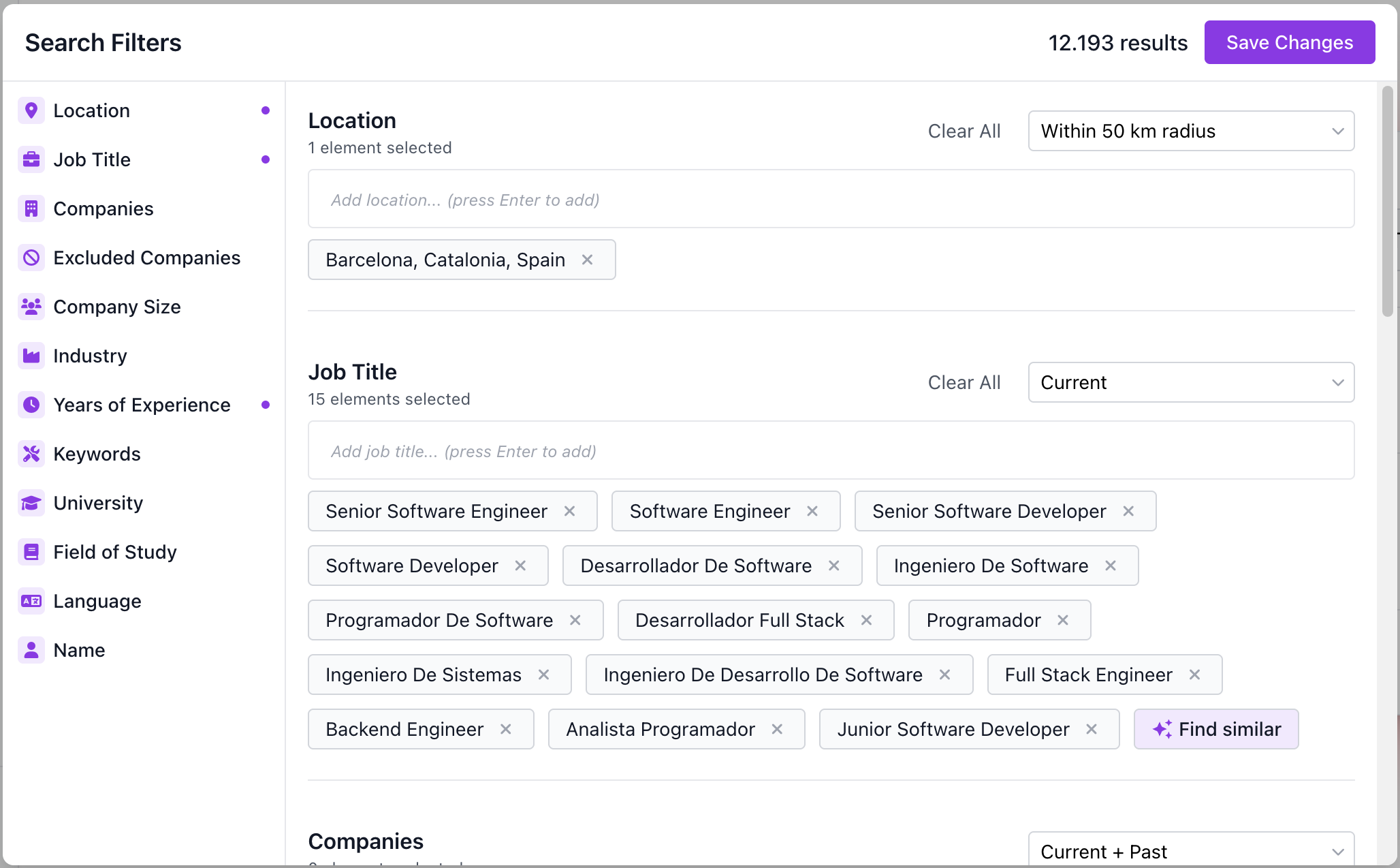
Filters (Defining the Universe):
- Software Engineer
- 5+ years of experience
- Barcelona
These attributes define the boundaries of who enters your candidate pool.
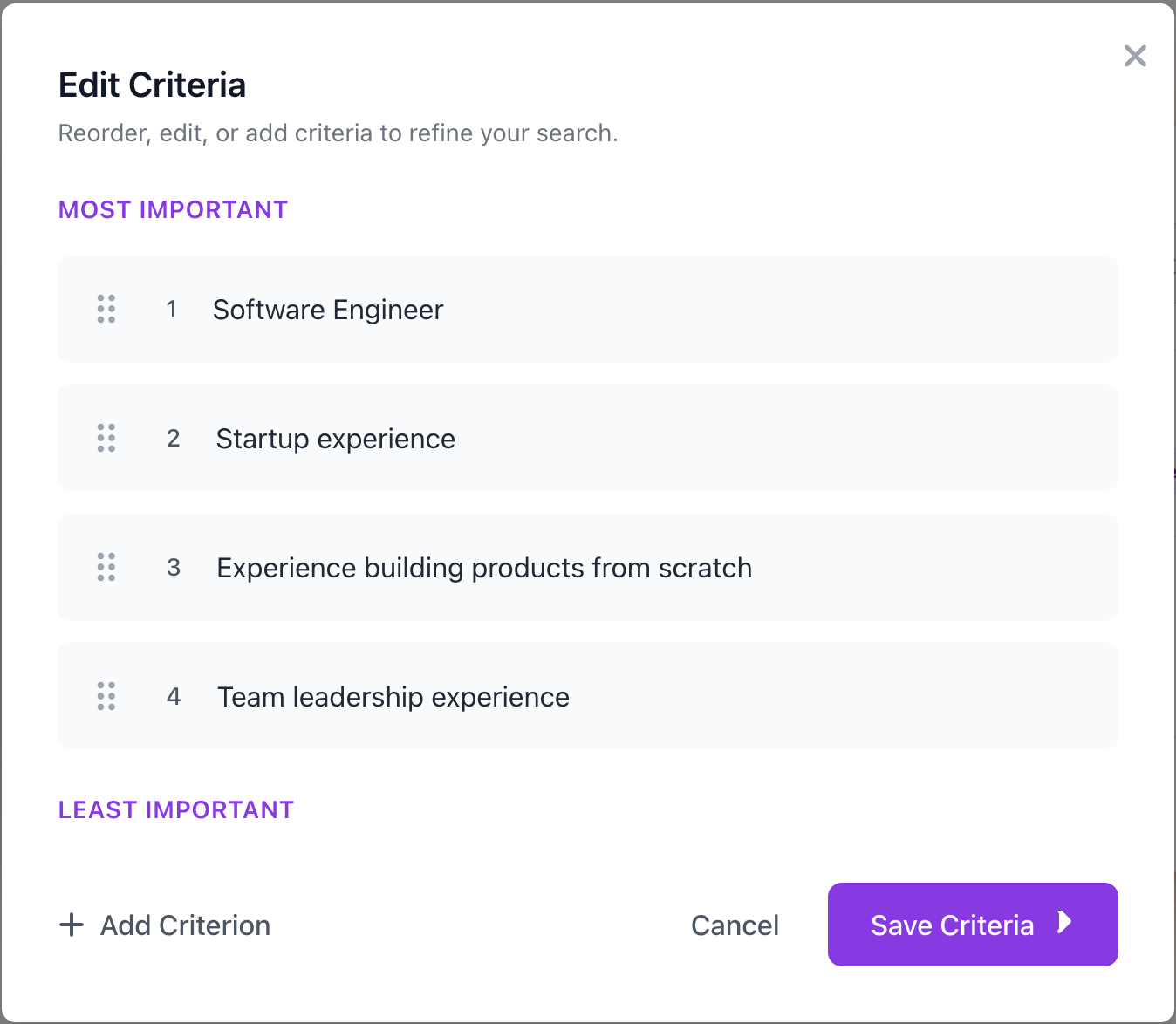
Criteria (Evaluating & Prioritizing):
- Startup experience
- Experience building products from scratch
- Team leadership experience
These requirements require interpretation and context, so they are evaluated by the AI on a profile-by-profile basis.
What is the ideal number of results after Filtering?
As a general rule of thumb:
- An optimal universe usually contains between 1,000 to 25,000 profiles.
- This range can vary depending on the specific role and the market.
If you get too few results, it is usually a good idea to:
- Relax a specific filter (e.g., expand the location radius).
- Move some requirements from the "Filters" section over to "Criteria."
Phase 2: Criteria (Evaluating & Ranking)
Once you have established your initial universe, Criteria come into play. Here, you aren't just filtering people out; you are evaluating and ranking profiles based on much more complex, abstract, or contextual factors.
Ideal use cases for Criteria:
- Specific Problem-Solving: Hands-on experience with a particular type of technical or business challenge.
- Quality of Experience: Determining the depth of a candidate's involvement in a project.
- Environmental Exposure: Identifying experience in specific contexts like startups, scale-ups, or informal leadership roles.
- Non-Literal Signals: Identifying traits that don't rely on specific keywords.
Note
Criteria do not discard profiles. Instead, the AI analyzes, compares, and ranks candidates based on how well they fit your specific needs.
Why this separation is key
This approach avoids the most common mistakes in modern recruiting:
- Filtering too early: Closing the door on talent before seeing the full picture.
- Small Universes: Ending up with a tiny, unrepresentative pool of candidates.
- Keyword Rigidity: Losing valid candidates due to the restrictive nature of booleans.
With Taleva:
- Filters define who enters the universe.
- Criteria decide who stands out within that universe.
This gives you full market visibility, total control over where you are willing to "flex" on requirements, and better decision-making based on real-world context.
Iterate Intelligently
You can refine your search at any time:
- Need to change location, seniority, or role? → Adjust your Filters.
- Want to refine which profiles fit the profile or specialized skill set best? → Adjust your Criteria.